
Why do carts leak?
Cabin pressure drops as an aircraft climbs, and that shift pulls trapped air inside a sealed cartridge outward, forcing oil past the mouthpiece or seal. Pressurised cabins rarely match ground level pressure exactly, sitting instead at a lower equivalent altitude, which still leaves enough of a gap to disturb sealed liquids during climb and descent.
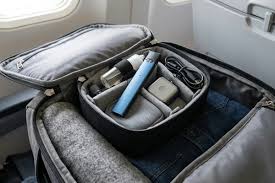
Many travellers pack Exhale Wellness THCa vape pens in checked bags or carry-ons without realising that pressure swings during takeoff create the widest gap of any point in a flight. Oil sits inside a chamber filled and sealed at standard ground pressure. Once altitude changes, air pockets inside that chamber expand, pushing liquid toward any weak point along the seal line.
Adding temperature to this process adds another layer. When temperatures stabilise mid-flight, oil thickens again after thinning briefly in cargo holds and overhead bins. Due to that viscosity change, oil sometimes moves more quickly toward the airflow path than it would under consistent ground temperatures.
What triggers oil expansion?
- Trapped air bubbles expand faster than the liquid can compensate, and that imbalance pushes oil through gaskets or airflow holes during ascent.
- Cartridges built with tighter tolerances resist this less predictably than others, since even a fractional gap around the coil housing gives expanding air a route outward.
- Descent reverses part of the process, but pressure rarely returns to its original state instantly, so a second, smaller release can occur during landing.
- Turbulence adds mechanical movement on top of pressure shifts. Shaking during rough air can loosen oil that has already migrated near a seal, releasing it even after cabin pressure stabilises fully.
Ground level adjustment
Once a flight lands, pressure returns close to sea level readings, though not always instantly, depending on cabin ventilation cycles. Several conditions after landing determine whether a cartridge continues releasing residual oil once removed from a bag.
- Reduced pressure gap slows further expansion but does not reverse oil that has already moved past a seal.
- Temperature recovery inside the cabin thins oil again, allowing trapped residue near the mouthpiece to drip once handled.
- Vertical storage after landing keeps the remaining oil away from the airflow path.
- Wiping external residue before use prevents transfer onto hands or fabric during unpacking.
Reducing in-flight leakage
Sealing a cartridge in a small resealable pouch before departure prevents any oil that escapes from spreading onto other items. Storing pens upright inside a bag, rather than sideways or upside down, gives expanding air less direct contact with the mouthpiece opening.
Partially used cartridges tend to leak more than full ones, since extra airspace inside the chamber gives trapped air more room to expand during pressure changes. Keeping devices at moderate charge and avoiding pre-flight activation also reduces internal heat that would otherwise thin oil right before cabin pressure begins shifting.
Altitude changes remain a physical reality of air travel, and any sealed cartridge carrying liquid will respond to those shifts in some form. Preparing for that response through simple handling choices keeps the experience predictable across most flights, regardless of cabin conditions or route length.